
What is ContextWorks
ContextWorks turns the data an agent needs — and the instructions for how to use it — into configuration. Curate views of your Salesforce data once and expose them on every surface: Agentforce, MCP, Prompt Builder, Flow, Apex.
The problem
An agent asked about a Salesforce record needs to know which fields matter, what they mean, and what surrounds the record. A raw query answers none of that — hundreds of fields to choose from, no signal about which are used or important, and nothing explained.
The usual approaches all have problems: hard-coded prompts drift and every change is a deploy; broad query access risks exposing fields the user can’t see and causes confusion about what data was used; bespoke Apex gets rewritten per agent.
What the agent should see is a business decision, and it keeps ending up in code.
What ContextWorks does
You create curated views of your objects — entities: which fields at which depth, what they mean, which related records travel with them, and which summary metrics (“open pipeline”) replace rows the agent would have to count. One call returns a readable payload, assembled live, filtered by the calling user’s permissions, with your guidance inline.
- Live. Payloads assemble at call time. No index, no sync job, no staleness.
- Permission-correct. Every query runs as the calling user — field-level security, object permissions, and record sharing apply. See Security.
- Curated. A human decided what belongs and what it means, once, for every surface.
- Governed. Every load is metered: tokens, latency, what survived permissions and held data. See Observing.
Expose on every surface
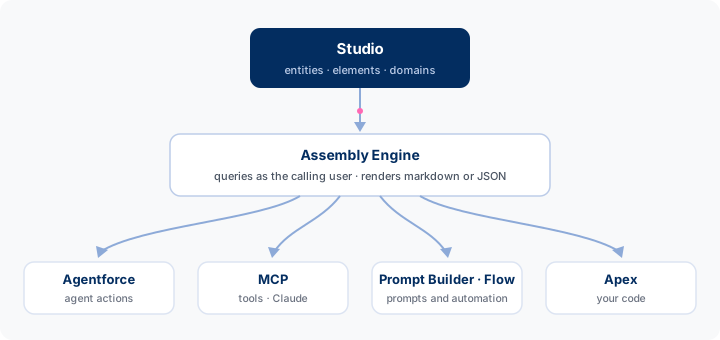
- One assembly engine. Agentforce and MCP make the same call; there’s no second implementation.
- Surfaces are thin. The packaged invocable actions are a few lines each over a public Apex API — write your own the same way (Custom tools).
- Two packages. The core package installs the engine, the builder, and the invocable actions. Agentforce users add an optional extension package — one click registers the four agent actions and a ready-made ContextWorks topic. It’s separate because that metadata requires Einstein generative AI. → Deploying
Who does what
- Admins, RevOps, and business teams own which fields matter and what they mean — Building is point-and-click.
- Developers extend it: an Apex provider, a custom tool, or the Apex API.
- Agent builders register the actions — see Deploying.
What’s next
- Getting started — install and see it working.
- Concepts — the model behind it.