
Your first entity
Curate the sample Account 360 entity — every step applies the same to an entity you create yourself. Started empty? Click + on the Entities page and pick an object; the steps below are identical from there.
Open the builder
Studio → Entities, then click the Account 360 card. The builder is one canvas showing everything the entity delivers:
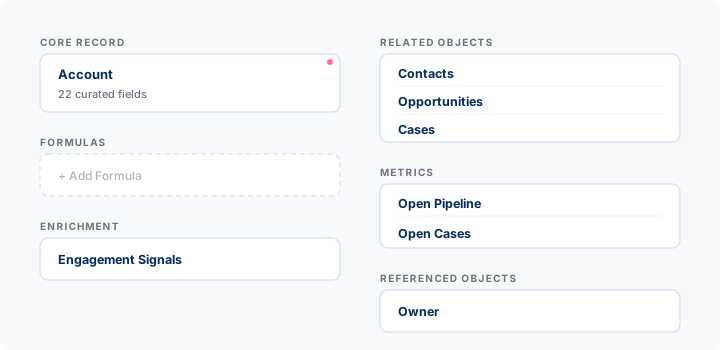
The canvas mirrors the payload: each section is a section the agent receives. Click a card to edit it; click a ghost card (+ Add …) to add one.
Edits stay local until you press Save, which writes the draft. Agent calls keep assembling from the active version until you press Activate — the bar under the header says Unsaved Changes or Edited Draft whenever the two differ, and goes quiet when they agree. See Versions.
1. Write entity instructions
Entity Instructions, at the top, is org guidance the agent receives with every load of this entity — the highest-leverage field in the product. Tell the agent what no field can:
Accounts here are paying customers only — prospects live in Leads. Treat an account with no open opportunity and a renewal inside 90 days as at risk.
Write it as guidance to a capable new hire. Don’t restate what the fields already say.
2. Curate the fields
Click the Core Record card to open the field picker. You’re choosing three lists, one per level, with caps of 10, 20, and 30 fields.
- Pick fields that inform a decision.
Renewal_Date__cchanges what an agent says;LastModifiedDaterarely does. - Curate
listfirst. Those ten fields are also the columns this record shows as in other entities’ related lists — enough for a human to identify the record. - Leave out mostly-empty fields. A field that’s rarely populated rarely informs. Quality shows how complete your entity’s data is once you have traffic.
3. Attach meaning to a field
In the field picker, a field can carry its own instruction, rendered inline with the value every time:
| Field | Instruction |
|---|---|
Health_Score__c | 0–100, refreshed nightly. Below 60 warrants outreach; below 40 is escalation. |
Type | ”Partner” here means a reseller, not a technology partner. |
Amount | Gross, before discount. Net is Expected Revenue. |
Put tribal knowledge here once — anything that would make a new hire misread a value — instead of in every prompt.
4. Add more context
Each + Add … card brings another kind of context onto the entity. What’s possible, with the how-to on each Building page:
- Metrics — a single number (“Open Pipeline: $40,000”) instead of rows the agent has to count. → Metrics
- Related lists — child records as rows, filtered and capped so the signal survives. → Related lists
- References — a parent record’s details inline, like the account on an opportunity. → References
- Formulas — arithmetic over this record’s fields, computed at load time. → Formulas
- Enrichments — computed context from Apex or Flow, for what configuration can’t produce. → Enrichments
5. Save, then Activate
Press Save. Your edits are on the draft — previewable and invisible to agents.
Press Activate. The dialog lists what changed and requires a comment — write why, not “update”:
Added open-pipeline metric; culled stale fields from detailed.
Confirm to publish the draft as v2 — every agent call now receives it, with nothing to deploy. If v2 is a mistake, Versions in the header rolls back with one action.
Creating an entity from scratch
Same builder, one extra step. Entities → Add Entity:
| Field | Note |
|---|---|
| Object | Any queryable object, standard or custom |
| Entity name | The label. “Finance View” |
| API name | Generated from the label; editable now, fixed after |
| Description | What this view is for. Admins and agents both see it |
The first entity on an object becomes its default and is seeded with a starting field list from the object’s layout; a second entity on the same object is a named view — see Entities. A new entity starts Inactive: agents read its draft until its first Activate publishes it.
What’s next
- Preview and verify — see exactly what an agent will see.